Understanding Humanity Is More Important Than Understanding English
Our survival as a nation depends on it.

The other day, I ordered a car from Uber, and then realized that I needed to change the pickup location slightly so the vehicle would come up a steep hillside driveway where I was waiting with three heavy pieces of luggage.
I availed myself of the “call driver” feature, but when I tried to explain, speaking slowly and clearly, and highlighting several words like “driveway” and “up” and “hill,” he said “no English.” He repeated that each time I tried to simply convey the instructions, so I gave up.
This interaction befuddled me, and I wondered why Uber, a “service industry,” doesn’t require its drivers to speak basic English.
I suppose, if my brain and heart were wired in a MAGA way, I could have taken a hostile, anti-immigrant approach.
I also might have taken the view that really gets the MAGA crowd worked up — the progressive left position that people like my driver are human beings like me, doing the best they can under very difficult circumstances, so I’d just have to accept it and do a work-around.
Which I did. I lugged my three bags down the hillside, he helped me put them in the car, and we were off.
Although we couldn’t converse, from his demeanor he seemed a nice enough man. From his name, I deduced that he was from Turkey. He appeared to be in his 60s, and he was a good driver.
Now, I have no idea what his story is, how, as an older man, he found himself in a strange country without even the most basic language skills, and how he managed to get approved by Uber — and, because my Turkish is limited to “thanks,” I wasn’t able to learn more.
I kept thinking about this throughout the day, because the experience somehow embodies the core challenges we must meet as a country and a society. Many people worldwide urgently need to improve their bad circumstances, and, with things like global warming and artificial intelligence displacing and replacing humans wholesale, this is sure to accelerate.
Faced with someone like my Uber driver, a certain kind of person would quickly go to their angry spot and clamor for a politician like Donald Trump to “send them all back where they came from.”
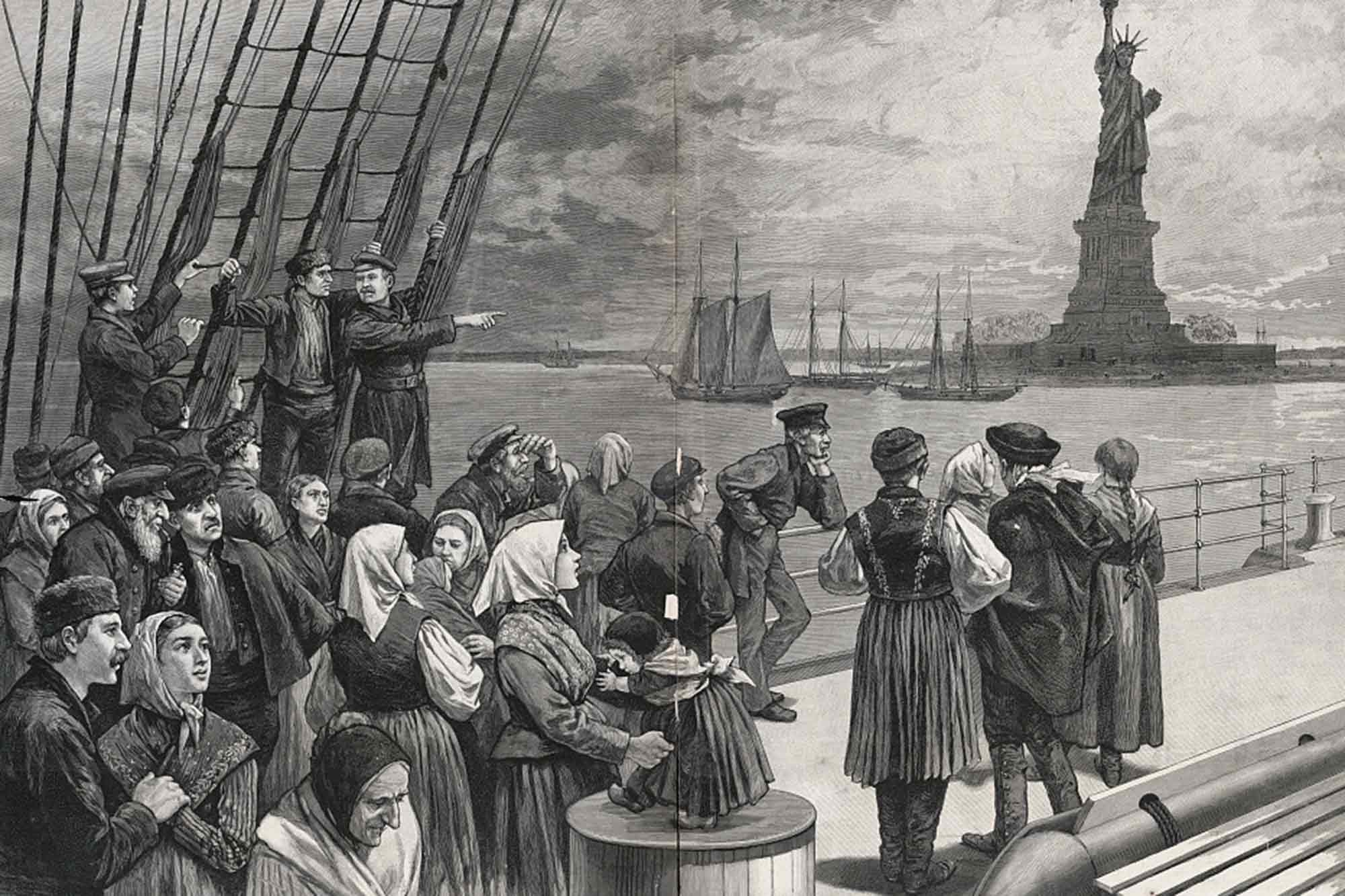
That sort of person might conveniently forget that, but for an ancestor who came to this country with little (or no) command of English, they themselves might not be long-standing citizens.
Another kind of person would find it objectionable even to question what this man was doing here, how he had come to be here, and would want him provided with every kind of aid and support.
Although I don’t line up with the MAGAs on this, I can understand why, if they have been repeatedly told that the “other side” embraces all such strangers in a way that robs them of some opportunity or right or expectation, they may go to a place of frustration and anger.
The fact that a lot of people in this country perceive the two viewpoints as equally extreme says something about how information is disseminated in this country. Because, in most cases, the reasonable response is, if not “in the middle,” at least being open-minded and willing to learn more.
For instance, MAGAs should consider three unambiguous facts: (1) Immigrants are not automatically put into Democratic voter rolls. It generally takes over a decade to become a voting citizen. (2) Economists broadly agree that immigrants are vital to the US economy. (3) Plenty of immigrant rideshare drivers are right-wing. I’ve lost count of all those I’ve met who extolled Orbán, Bolsonaro, Erdoğan, and, yes, often, Trump.
Although the points above should be easy to understand, it’s the unenviable task of politicians to explain that things are not simple in most cases. They need to remind us of this because it is true.
And yet, at the same time, they are rewarded at the ballot box for pandering to one extreme or another, and promoting the over-simplified and even outright false ideas that are being constantly reinforced by invisibly generated algorithms.
It takes a particularly sophisticated constituency to embrace nuance and subtlety.
And this is where quality media comes in: probing this man’s story and those like it, finding out about him and about the larger implications around his situation, and explaining as clearly as possible what we find. Once we “figure it out,” we don’t have to be shy about expressing an opinion. But we shouldn’t have any opinions until we do.
PS: I again ran into my new old friend Diego — the North Beach, San Francisco poet — and, as always, he handed me a poem. And I recalled that, though his heavy Italian accent might seem to mark him as a fairly recent immigrant, he has in fact been in this country for most of his 90 years. And his poetry speaks to me.
Humanity is so often put upon to exercise judgement, such that Christianity I think left such matters to a state that should come after the one we know while we're here. Meanwhile we're free as might be to illustrate our concerns in a hymnody I like to go to every so often-- https://youtube.com/watch?v=papU0gaxOHk .
We all came here from someplace else. I was reminded of this when I recently re-discovered a log I kept in 1970-72 when I was building my own house after getting out of the Army. In this log I kept track of all the subcontractors, hires, service providers, etc. I was surprised at the number of ethnicities/nationalities represented in the log (judging solely by surnames).
I had worked with or employed people of numerous immigrant ethnicities; I can name FOURTEEN different ones in the building of my house—Spanish (mason), Irish (excavator, surveyor, engineer), Russian (carpenter), Hungarian (carpenter, blasting), German (electrician, surveyor), Ukranian (painter), English (carpenter, septic, well, architect, laborer), Italian (mason), Scot (plumber, lawyer), Dutch (tiler), Polish (refuse hauler), Czech (drywall), Finnish (excavator), German/Jewish (attorney). This catalogue is more than 50 years old. I had no awareness at the time of their (assumed) origins. I note, also in retrospect, that my list doesn't include, though it was not my intent, African-Americans or Hispanics. Today that list would be even more inclusive. Everybody has something to contribute--if not right now, always eventually.